
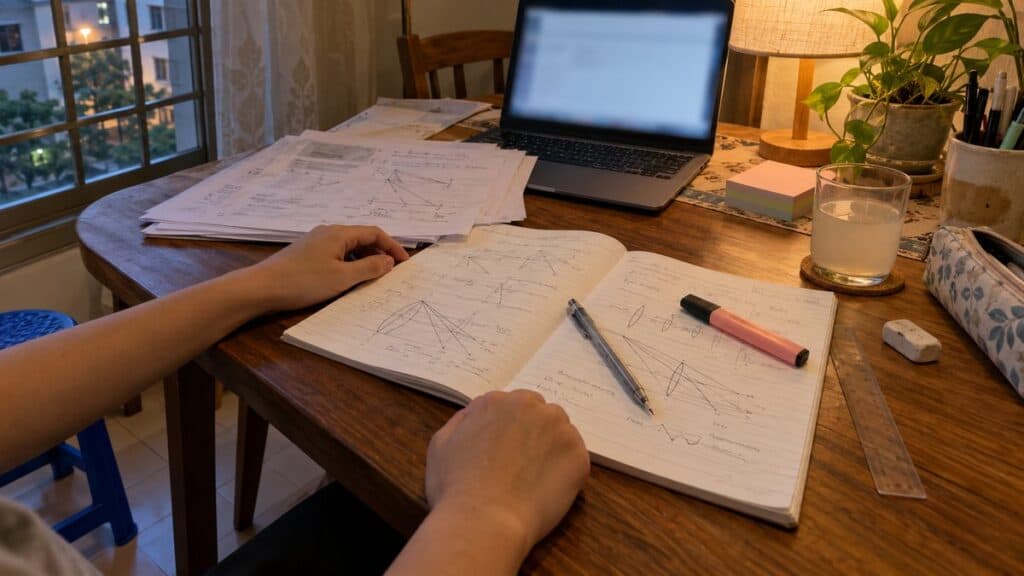
Study Strategies for Secondary Physics Students in Singapore
Revise physics by how the exam is set, not only by the chapter list. The three O-Level Physics papers test different things, so one study routine will not fit all three. Paper 1 has 40 compulsory multiple-choice items. Paper 2 has structured and free-response questions, including a data-based question worth 8 to 12 marks. Paper 3 is practical, and students may not refer to notebooks or textbooks during the assessment.
The syllabus also uses command words, which signal what kind of answer is expected. Knowledge questions often begin with define, state, name, describe, explain or outline. Handling questions often begin with predict, deduce, suggest, calculate or determine. Read the command word before you write. It shows how much to write and what to practise.
This article uses the SEAB O-Level Physics syllabus (Syllabus 6091) as its reference. The tactics below are suggestions, not research findings, so check them against your school’s advice and the syllabus.
Paper 1: multiple choice
Paper 1 rewards precision. Options can differ by a single word, such as a unit, a direction or a condition. Three habits help.
First, practise short, precise definitions. Write each one in your own words, then check it against your notes.
Second, practise quick calculations and check units before you choose an option. A unit that was not converted is an easy mistake to make.
Third, review every wrong option, not just the answers you got wrong. For each item, ask why the correct option is right and why each other option fails. Keep the note that explains the mistake.
Pace matters too. If an item is not coming to you, move on and come back to it at the end of the set. Time lost on one item is time not spent on easier questions later in the paper.
Paper 2: structured and free response
Paper 2 asks you to show your reasoning in writing, so the command word matters. A question that says “state” usually needs a short, exact answer. A question that says “explain” needs a cause linked to its effect, with the reason stated. A question that says “suggest” or “deduce” often asks you to use information given in the question. Identify the command word first, then decide how much to write.
The data-based question is worth 8 to 12 marks, so it deserves regular practice. Read the table or graph, check the axes and units, describe the pattern, and then use the pattern to reach a conclusion. Practise with past-paper data and write full sentences.
Sorting past-paper questions by command word is a useful way to revise. Practise all the “explain” questions together, then all the “calculate” questions. You may quickly see which command words cost you marks.
Match the length of your answer to the marks. On a two-mark question, aim for two clear, separate points, not one long paragraph that makes the same point twice. Count your points before you write.
Paper 3: practical
Paper 3 is assessed without notebooks or textbooks, so practical skills need to be ready before the exam. The syllabus lists experimental skills such as following a sequence of instructions, making and recording observations, measurements and estimates, planning investigations, and evaluating methods and suggesting improvements. Planning is assessed separately from the other skill areas, so do not leave it until the final week of revision.
Practise recording readings in a neat table with headings and units. Practise planning by writing the question, the variables, the apparatus and the steps before you touch any equipment.
After each practical, write one improvement. Ask what limited the accuracy, such as a measuring instrument, a timing method, or a variable that was not controlled, and what you would change. This gives you practice in the evaluation skill the syllabus lists.
A weekly revision routine
The routine below is one suggestion. Adapt it to your timetable.
- Revise concepts first. Read the topic, then write the key definitions and laws in your own words. Do not start with formulas alone.
- Attempt past-paper questions on the same topic, sorted by command word.
- Keep an error log. For each mistake, note the question type, what went wrong (a misread command word, a missing unit, a vague definition), and the correction. Read the log again at the start of the next week.
The error log only helps if you read it. When it shows a different gap, change the routine to match.
For parents
Parents do not need to teach the physics to help. The useful checks are about routine and reasoning.
Ask your child which papers they are preparing for and what each one tests. A child who can name the three papers and their main skills has a clearer plan than one who only knows the chapters.
Look at the error log together once a week. Ask which mistakes keep coming back, and whether each is about a definition, a unit or a command word. Each of these is a specific thing to fix.
Ask whether practical skills are practised as well as content, especially planning and evaluation.
Ask your child to explain a topic aloud in their own words. This can show whether the idea is understood or only read. It is a suggestion, not a proven method, but it costs nothing to try.
For the official details, read the O-Level Physics syllabus (Syllabus 6091) on the SEAB website. Check the weighting table in the current SEAB syllabus before deciding how to split study time between topics and papers.
Where tuition can fit
Some families also look for structured practice outside school. If so, treat o level physics tuition as one option among several, alongside school tests, past papers and feedback from your child’s teacher. Choose any option only if it gives your child practice in the paper structure and command words described above.
Checklist
- I can name the three papers and what each one tests.
- I can list the command words and say what each one asks me to do.
- I have practised the data-based question this month.
- After each practical, I have written one improvement.
- My error log has an entry from this week.
- I have checked the weighting table in the current SEAB syllabus.